Hi Aelf Crew,
I have saved this last and final fourth instalment of my time in Mongolia to touch on general points, covering food, cultural etiquette, itinerary tips and things I missed. Hopefully a useful wrap-up for readers if you’re considering a trip to this extraordinary country.
Weather & When to Go
Because Mongolia has a high altitude and is far from the sea, it has an extreme continental climate, with very cold winters (temperatures can reach as low as -30 ° C) and hot summers that can reach up to +27 ° C (particularly in the Gobi Desert).
I went at the end of April, with highs of 9°C and lows of -6°C, explaining why I woke up to heavy snowfall in my ger in Kharkhorin!
Peak season is June to August, when the landscapes are at their most beautiful and temperatures are at their highest.
Food and Drink
You can’t drink the tap water and instead, you’ll often be given boiled water (making it safe to consume), with salt added to help replenish nutrients lost in Mongolia’s extreme weather. I personally found this hard to get used to (warm, salty water isn’t exactly refreshing), so I stuck to bottled water when I could. Top Tip from Aelfgifu: stock up whenever you see a shop, especially if you are headed into rural areas.
A common dish is Tsuivan (Цуйван) – pictured below on the right – which is a noodle dish with meat and vegetables, most often mutton. It is a meal that is simple but nutritious for the cold winter, and can be prepared quickly with minimal resources. Again, the salt content was too much for me but I can imagine that is due to the climate and dietary needs as a result.
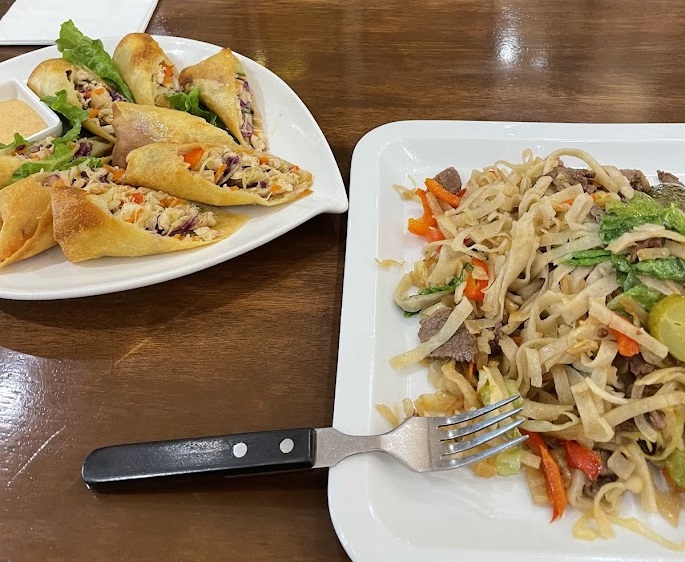
I did try to get my hands on some fermented horse milk but I was advised that during winter, Mongolian’s don’t milk animals so was not readily available. In summer season, dairy products are more popular.
Safety
I felt safe walking around Mongolia. Statistically, it is one of the safest countries in Asia, ranked as the 8th safest country in Asia after countries such as Singapore, Japan and Kuwait and 40th in the world. I definitely did get stared at, but this is a feeling that I am very used to, so doesn’t phase me. Like anywhere though, when you stand out like a sore thumb like I did, just be mindful of your surroundings and respect local customs.
Cultural Etiquette and Local Customs
- Handshakes: Handshakes are common, and it’s polite to shake hands with the host or anyone you’re introduced to.
- Respect: Show respect for elders, and don’t walk in front of them.
- Fire: Fire is considered sacred, so don’t throw rubbish (‘trash’) into it or put water on it.
- Gifts: When visiting nomad families, it’s customary to bring a gift, such as food, sweets, or alcohol.
- Refusing Offers: It’s impolite to refuse food or drink, even if you’re not hungry – take at least a bite or sip.
- Sleeves: Keep your sleeves rolled down – exposed wrists are considered rude.
- Clothing: Don’t wear outerwear like coats while eating as it implies your host hasn’t kept you warm enough.
- Right Hands: Always receive offerings with your right hand (avoid using your left to take food from a communal plate).
- Photography: Respect Buddhist monasteries and be mindful of taking photos – particularly in temples.
These are fairly common general etiquette points (albeit some are more specific to Mongolia than others), but I thought worth mentioning as basic manners and small efforts go a long way.
More generally, I think it is always good practice to learn a few words of the language before going anywhere (e.g. thank you in Mongolian – баярлалаа (pronounced phonetically ‘bayarlalaa’).
Itinerary

Art has never been my forte, however I made a rough colour-coded map to track where I went and what I missed:
- Red is Altai Tavan Bogd National Park
- Blue is Lake Khovsgol
- Pink is Kharkorin
- Lime is Ulaanbaatar
- Black is Gobi Desert
I was not able to go to red and blue in my time, however if you look up pictures, you will see how absolutely stunning they look – and if you have more time than me, please let me know below if you make it there and let me know your thoughts!
To give you an idea of distances, it took around 8 hours by bus between lime and pink, so plan accordingly!
Money
When I travelled, the exchange rate was ₮4,900 Mongolian Tugriks to £1.
I had read online that whilst card is increasingly accepted, cash is preferred especially outside of Ulaanbaatar. I couldn’t find a single currency exchange shop that had them readily available in the UK.
There are ATMs widely available in Ulaanbaatar to withdraw cash and I would recommend doing this with a travel debit card (such as Revolut).
I converted the equivalent of £50 a day, as I didn’t know what to expect and like to be prepared.
Top Tip from Aelfgifu – this was far too much – I ended up having to exchange a fair amount at the airport again.
Let me know below if you’ve been to Lake Khovsgol and how you found it!
When all is said and done, more is said than done,
Aelfgifu
 Aelfgifu Travels
Leave a comment